Hindsight is 20-20
This was a genius plan. Claude would evaluate all my chats so far and tell me what to improve and why. Then, I could compile all the outputs, supplement with some light research, and synthesize a set of prompting tactics. What could possibly go wrong?
Turns out, I missed one crucial question: In other words, would the ‘feedback’ it spit out be accurate and true, or would it confidently hallucinate some supposed best practices? Would it capture a comprehensive list of tactics, or would it miss some because they’d never come up during my prompts?
I recognized this error later and course-corrected (the subject of the next Notebook). That didn’t stop me from spending time pushing down this first path. In this Notebook, I lay out what I did and what I learned while pursing this incorrect course of action.
Ask and you shall receive
To get feedback, I used the following prompt:
Let's pause on the hub for now. Instead, I want you to evaluate my prompts in this chat. In particular, I'm looking to analyze whether the prompts were effective and efficient. What are some tactics or techniques (with examples) that could have made this a more efficient and productive session?I copied and pasted this across all 4 of my sessions. Claude provided it’s output in chat. At the time, the results sounded astute and helpful. I took them at face value and was caught up in the excitement of quick, seemingly helpful results (for simplicity for this post, I have compiled all the outputs into a single document, including links to the chats the feedback came from).
I did notice a couple inconsistencies across the outputs. For example:
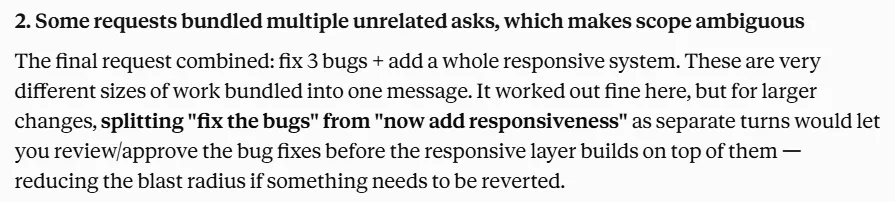
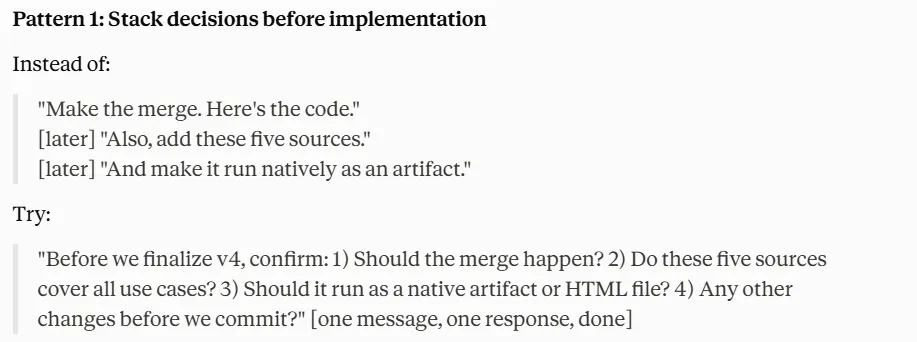
This should have been the moment to stop and reevaluate my approach. It did set off some alarm bells, but I chose to ‘fix’ the outcomes (as you’ll see later) instead of recognizing that there may be a problem in the quality of the feedback.
From feedback to tactics
Feedback in hand, I spent some time thinking about what I actually wanted to achieve:
- Durable actions: Concrete, impactful tactics that I could incorporate into every prompt to make them better.
- Accountability: A way to quickly validate that I was actually implementing the tactics well.
- Synthesis: Resolve the discrepancies I was seeing across the feedback.
Actions and synthesis went together - I would make Claude review the different sets of feedback, use external research as a tiebreaker to reconcile any differences, and extract a set of tactics into a standalone document.
To address accountability, I came up with the idea to create a scorecard. This would map the tactics to signals to look for in prompts, theoretically making it easier to judge whether the prompt was good or needed improvement.
Here’s the prompt I came up with to start this work:AsideHow I compiled the initial feedbackI used the upload text option in the Project’s shared context. This was cleaner than copying all the text into a giant prompt, it helped keep the various outputs more organized, and it let me test the functionality of Projects more. Additionally, the feedback from Claude wasn’t going to change, so this was a little future proofing in case I needed to start multiple chat threads on this topic.
In this project, we built a prototype of a tracker for updates for the Rainbow 6 Siege video game across 4 chats, involving prototyping, visual designing, debugging, and auditing. From each chat session, I gave Claude the following prompt: "Let's pause on the hub for now. Instead, I want you to evaluate my prompts in this chat. In particular, I'm looking to analyze whether the prompts were effective and efficient. What are some tactics or techniques (with examples) that could have made this a more efficient and productive session?"

The responses from each chat have been uploaded to this project as files (Feedback 1, Feedback 2, Feedback 3, and Feedback 4).

My goal is to improve my prompting for the future. I want to develop techniques that deliver accurate results, minimize duplicate calls, increase speed in responses, and optimize on token usage.

Our task now is going to be summary and synthesis. I want you to do the following:

1. Evaluate all the feedback critically. Use high-quality external sources to validate (minimize time online, and document the sources used). Check to make sure the feedback is accurate and makes sense, especially in the context of my goals listed above. (no direct output to me needed)
2. Create a summarized, condensed Prompting Tactics document that synthesizes the main takeaways and key tactics. This should be a digestible but actionable document I can use to learn. Cite sources here. Include short explanations of each tactic, any limitations or considerations, an example of a positive use of the tactic and an example that would benefit from using the tactic.
3. In chat (not in the Prompting Tactics document), list out any feedback that was inaccurate in step 1, what you corrected it to, and where you found evidence for that change.
4. Create a second Prompt Evaluation Scorecard document. This should be a tool I can use to check my prompts against the tactics and techniques documented in the Prompting Tactics document. This should also be something I can pass through an AI so it can evaluate my prompts as well. The scorecard should be unambiguous. Any AI using the scorecard should have the lowest likelihood of error or hallucination possible.

Before executing these steps, please confirm your understandingIt’s the journey, not the destination, right?
Despite the outcome missing the mark, going through this experience was valuable. There were several takeaways that I could use in my next iteration.
Once I saw the first tactics document and scorecard, I noticed potential gaps in the outcome and had ideas to make the output more useful. Some examples:
- Additional tactics: I already had Claude doing external research as part of the tactic synthesis. I had an opportunity to add new tactics to the list beyond the ones from the Claude feedback. This would have saved additional passes to go back and re-read the same research.
- Tactic impact - Instead of just a list of tactics, I could code each by it’s impact to making a prompt better. I end up doing this later, but including this step at the start would have eliminated an additional pass to think about each tactic’s impact.
I started to implement these leading to more time sunk in and avoidable iteration if I had planned my output better. For instance, my next prompt asked Claude to add in new tactics from the research. I also asked it to validate the research it had already found:
Thank you. This output is looking good. Before testing the scorecard, I want to run a few validation steps. All of these should use the same sources referenced in the Prompting Tactics document. All validation should make use of the external sources, not internal memory.

1. Do the tactics make sense compared to the literature? Was there any hallucination of any kind, either in the tactics or the examples? If there is, correct it in the Prompting Tactics document, and make the corresponding update in the scorecard document.
2. Is the current tactics list missing any high-value techniques or best practices that are included in the literature, even if it wasn't in the initial feedback? If so, update the tactics document and the scorecard to include these ideas.
3. Validate that the scorecard document matches the tactics document. If not, make the necessary changes to the scorecard.
4. Validate that the scorecard document can stand alone and doesn't require the tactics document to be comprehensible (no unexplained references). If not, make the necessary changes to the scorecard.

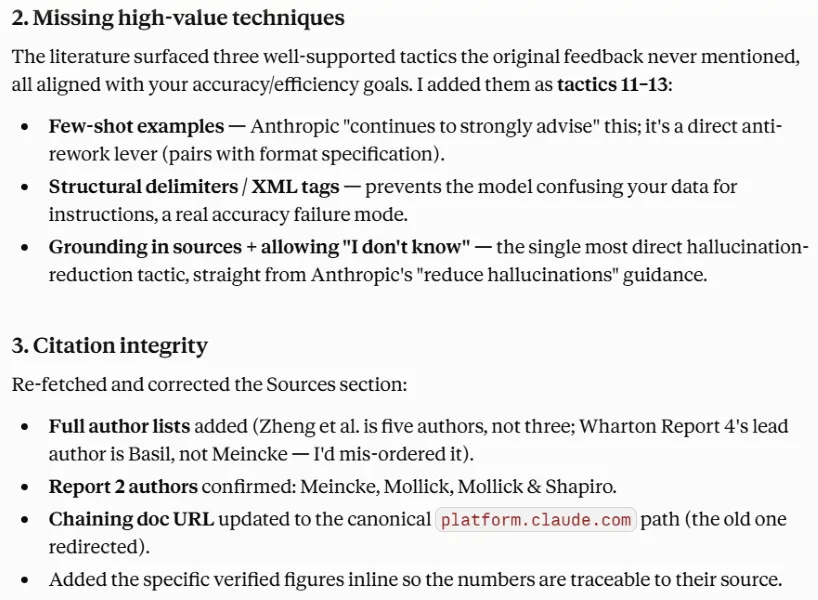
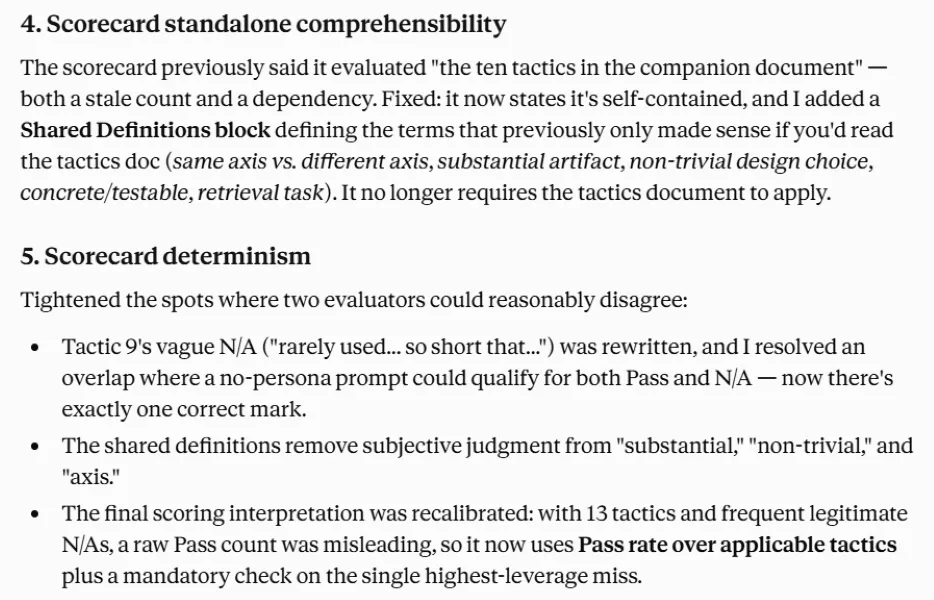
Before executing this work, are there any other validation steps you would recommend including?What was cool was that Claude identified some additional validation steps it should run:
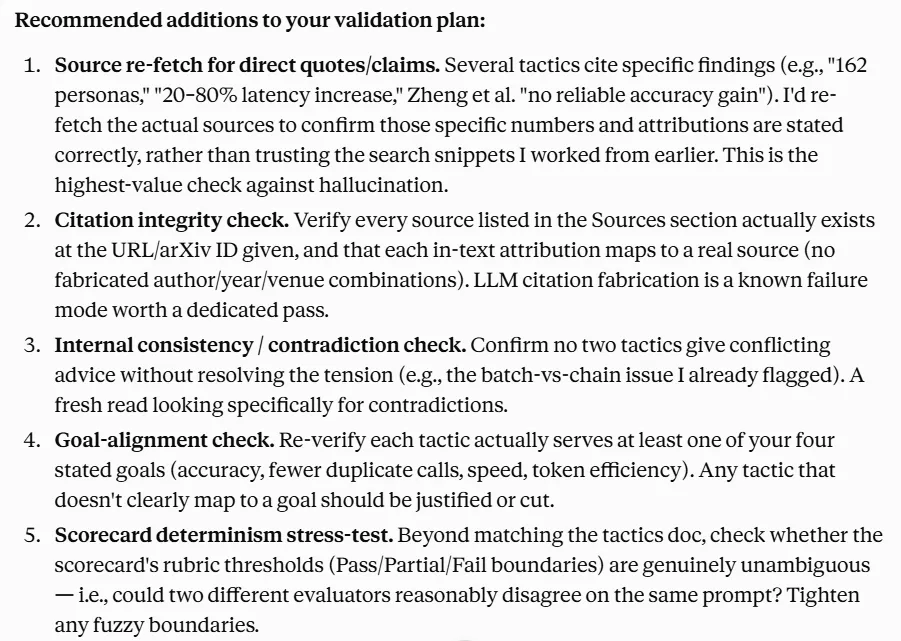
What was less cool was that issues were identified at all - ideally, this validation should have been included in the first pass.
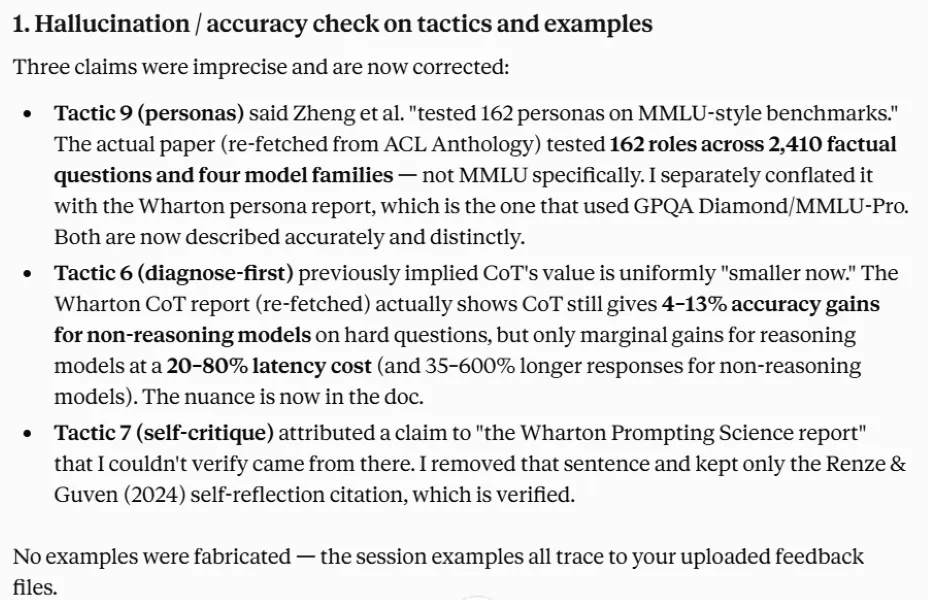
A for effort
At this point I’ve probably belabored the point - I learned a lot but had a pretty untrustworthy set of tactics. Past me hadn’t realized this and was merrily moving on to improve the scorecard part of this project. Bad input means bad output, so the actual scorecard I developed here wasn’t useable. However, this was a part of the process that went fairly smoothly, so I wanted to share what worked well.
Taking stock quickly - I had:
- A “finalized” tactics document
- Claude’s first pass at a scorecard
Trusting the scorecard at this point wasn’t going to work - it was untested and unknown if it would accurately assess the tactics we had landed on.
By now I was recognizing that my “just do it” approach wasn’t super effective. This worked like a charm. Instead of tons of back-and-forth, I completed the work with just 5 prompts, 1 test run, and 1 document update:
- One prompt outlining my desired testing approach. I included:
- A clarification step (having Claude pause to ensure alignment)
- A validation step (having test results validated in the same run)
Great. Let's dry-run the prompt scorecard. I want you to evaluate my first 3 prompts from this chat (do not count the Q/A responses. The first prompt starts with "In this project, we built a prototype...", the second starts with "Thank you. This output is looking good..." and the third starts with "One thing I noticed - the new tactics...")

Here's the process I'd like you to follow for each prompt. Follow this sequentially and return the output in a table format:

1. Critique the prompt yourself without using the scorecard. Create a short (4-5 sentence) evaluation. Include what worked, what could be better, and an overall rating (Ship it, one cleanup pass, high risk of rework)
2. Then, evaluate the prompt using the scorecard we created.
3. Finally, share a summary verdict of where the scorecard was strong vs where it was weak. Be self-critical; your feedback may not have been the best and the scorecard may have been better.

Prioritize accuracy for this ask. Include a validation run on the results before sharing them.

Before executing this, is there anything you need to clarify to ensure a successful outcome?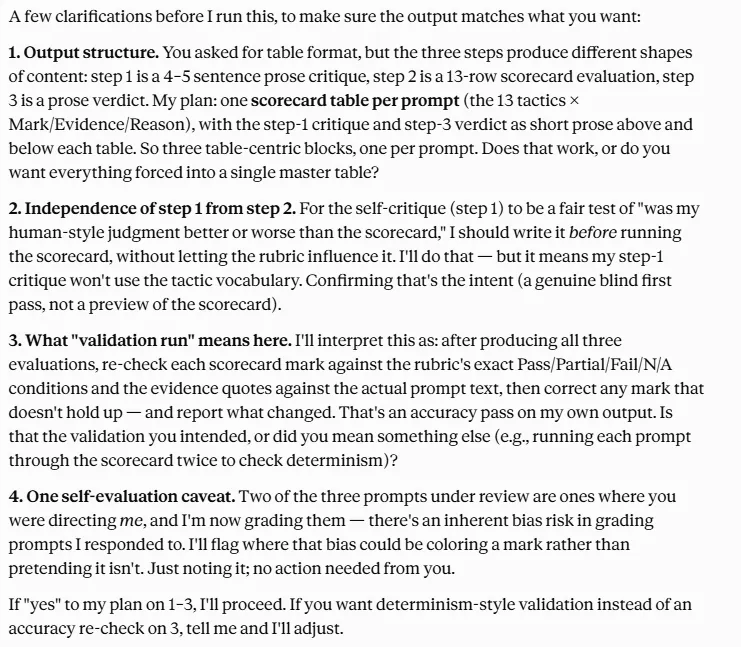
- One question to address the issues raised by Claude. I added a pause point prior to executing any testing.
Your plan on 1-3 works for me. I understand the bias risk here. Do you have any suggestions for how to minimize this risk? I was not aware of any so was ok accepting the outcome, but open to suggestions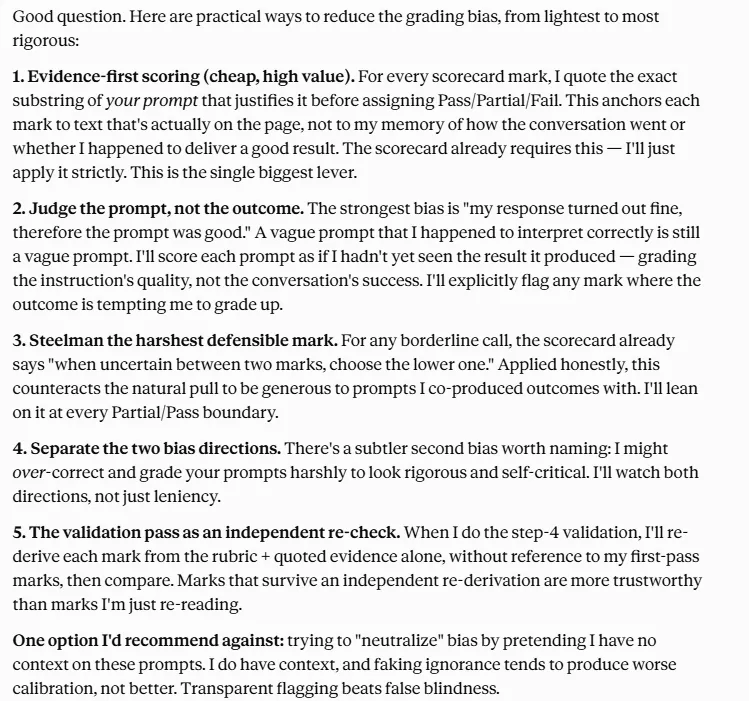
- One go-ahead prompt to execute testing.
Let's proceed with techniques 1-5 applied. You are correct that the primary objective here is to test the scorecard mechanics.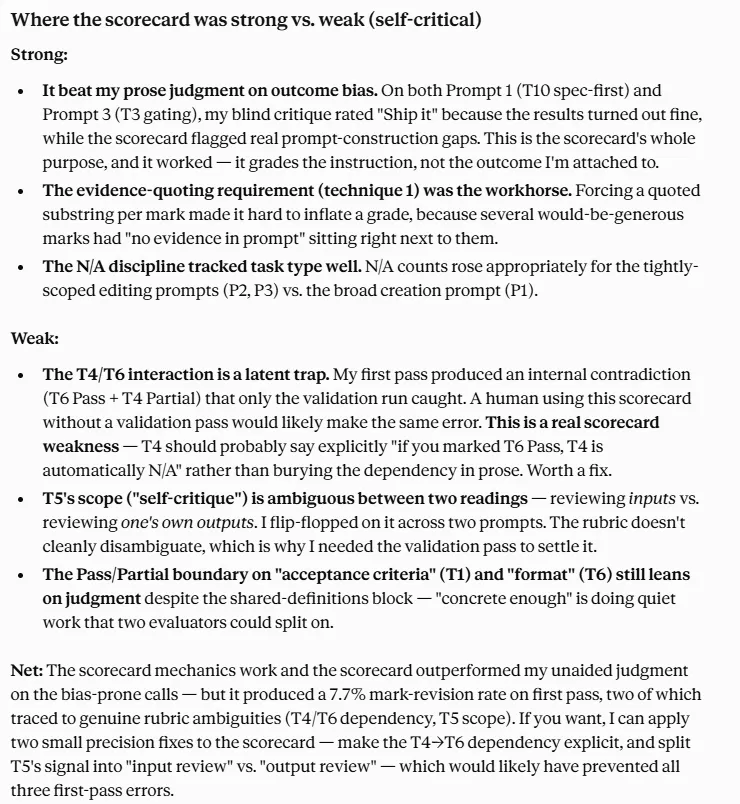
- One prompt to clarify the updates to make to the scorecard. I added an explicit ask to align on the decisions before executing any document updates.
These are exactly the kind of issues I was hoping to catch. Yes, we should make updates, but before doing so let's make sure we're aligned on what those updates need to be:

- T4/T6 interaction - this seems like the biggest weakness, as you pointed out. However, your proposed fix creates a bit of a recursive loop (T4 evaluation --> T6 evaluation --> recheck T4). I think a clean scorecard would eliminate that. To correct this, I suggest re-ordering the tactics and the scorecard such that current T6 becomes the new T4. I think that also improves the overall logical flow. What do you think? Let's discuss before executing.
- T5 - could you explain a little more what the distinction you're making here is? Maybe showcasing this using prompt 1 as an example would be helpful.
- I'm a little concerned about the statement that T1 and T6 lean on judgement. How can we make this more concrete? Open to suggestions here
    - For T1 - Perhaps removing the "concrete" language is good enough. That would mean the evaluation needs to check that "acceptance criteria are testable", which feels less judgement driven. Thoughts? Be critical here.
    - For T6 - similarly, what if we change the "partial" categorization to read "Format is stated for some outputs but not others; OR format is implied ("a summary")"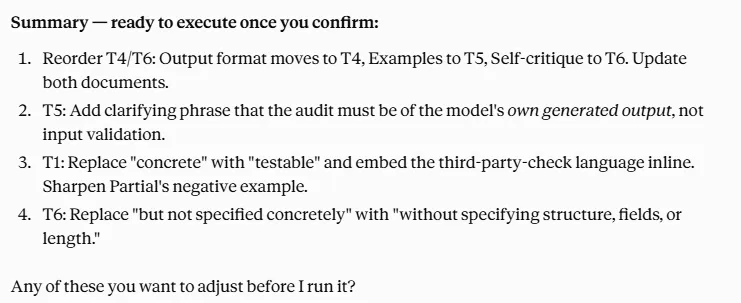
- One go-ahead prompt to implement the scorecard updates.
Aligned with the updates. One confirmation:

1. You correctly noted that the reorder direction impacts both files. When doing this work, you will a) not adjust any of the content, only the positions, and b) you will update this holistically through both documents (i.e. all sections and all references will be updated)? If this is correct, please execute

All other steps make sense to me. Please include a validation step to check your output after the updates are made.What next?
I wanted to make the scorecard easily usable anywhere in Claude, which seemed to match the use case of a Skill. I discussed an approach/strategy with Claude and even started the process of making the skill. Luckily, my usage ran out halfway, pausing Claude before it could expend a ton of effort. I went to bed planning to resume the work the next day.
This break gave me the necessary space to reach my horrible realization - my whole approach had been built on a shoddy premise. First, I berated myself for wasting time and not thinking of this issue earlier. Then, I decided to redo the work from the ground up. Even though the outcomes were unusable, the intent still felt good, and I was now armed with knowledge of what to do differently.
In the next Notebook, I will discuss my strategy pivot and how I created an updated Tactics document.
Here’s a link to the full chat so you can see all the pieces! https://claude.ai/share/a4127358-d544-46ed-9487-16a7f0dd16e5